From counting output to owning outcomes
The first shift, from narrow specialists to complete craftspeople, was about potential. With AI at their side, people can become complete: own the whole skill set of their product and pick up new skills when the work needs them.
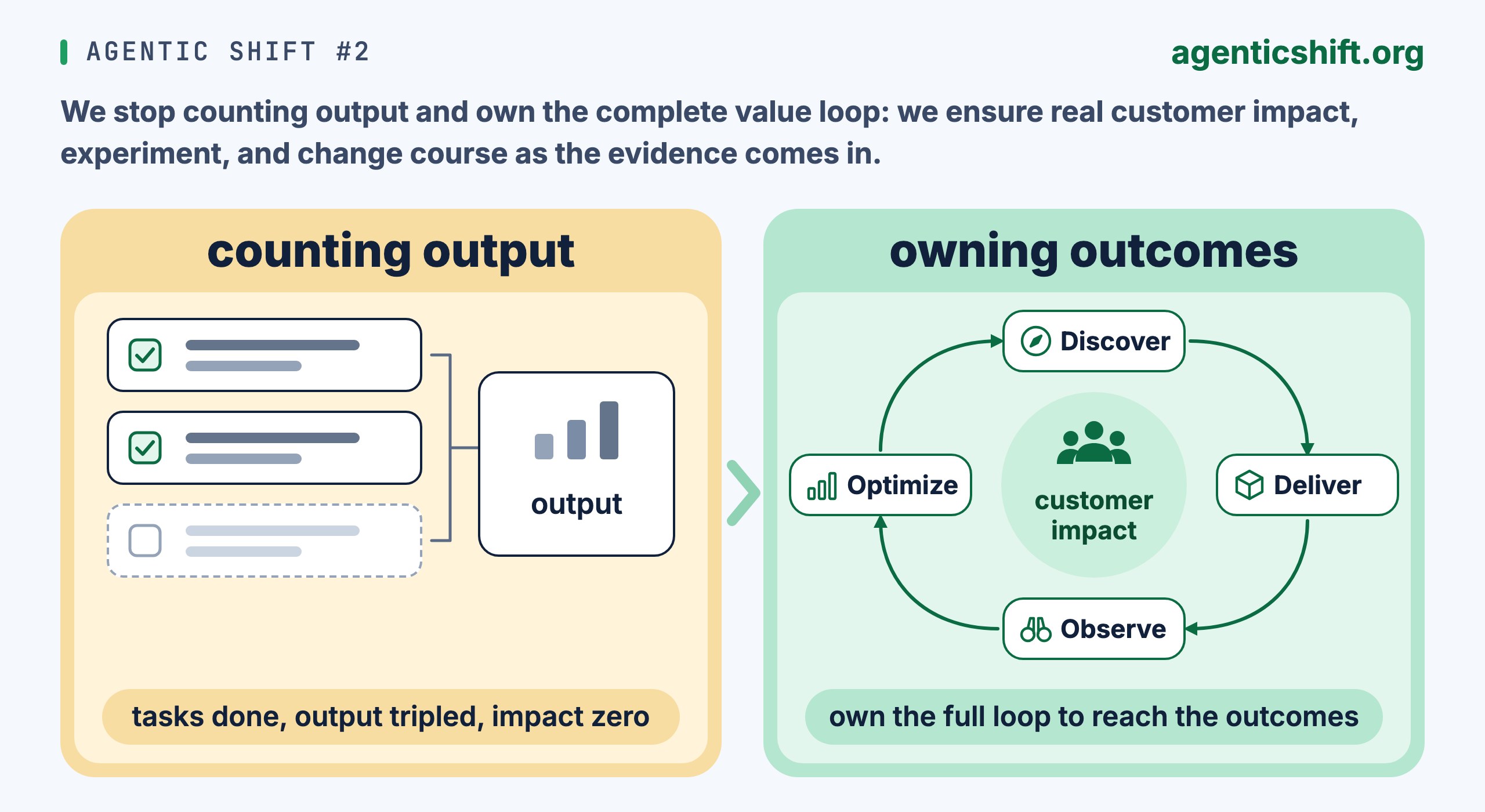
But skills only matter when they meet relevant work. Give a complete craftsperson a queue of tickets that nobody connected to a customer, and the new skills mostly go to waste. They just produce more output, faster.
And output is now cheap. With agents on the team, a team that closed 40 tickets a sprint can close 80. If your dashboard counts output, this will be its best quarter ever. Much of how we measure teams historically grew up when output was scarce: story points, velocity, features shipped, tickets closed. With AI, producing more is the easy part, so those output metrics no longer make sense. What stays hard is knowing whether any of it solved a real customer's problem and drove the expected business impact.
That is what outcome metrics measure. But you can only measure a person or a team on outcomes if they are allowed to own one. In many organizations they aren't, for two structural reasons.
First, the team's job ends at “done”. The feature ships, the ticket closes, and someone else, a product manager or a business unit, finds out months later whether it worked. The team never sees the evidence, so it can't change course.
Second, teams are fenced in by what they were made to own. This is traditional org design: teams own parts of a larger system, such as its applications, modules or components. But customer problems know nothing about our legacy org design decisions and respect no boundaries. To make it even more complicated, the boundaries of customer demand shift over time. So in a static organization, where each team owns one part, any real customer problem cuts across several teams, and no single team can carry it from discovery to evidence. Each one can only report that its part is done. That is why this shift goes hand in hand with shift #5, from owning components to cocreating the whole.
Owning outcomes means removing both fences, so the team keeps the whole loop: it discovers what customers need, delivers, observes what actually happened, and optimizes, which includes dropping the idea that didn't work. Only then do outcome metrics make sense.
Learn more Org Topologies map: the vertical move, toward a broader scope of work
Historically, this was a hard sell: making teams own the whole loop, end to end, meant asking a few people to master too many skills and too much of the system. In the agentic age it is becoming more and more feasible, because agents fill the skill gaps and help people learn an unfamiliar part of the system fast. The shift is possible now. Leaders just need to drive it.
So look at your teams. Does each of them own a part of the system, or a customer outcome? And what happens when an outcome crosses several teams' territories? Do you add extra roles and processes to manage the dependencies, or even wrap the change in an overcomplicated project management framework?